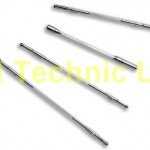
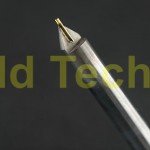
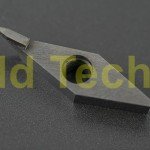
We provide the solid-state laser industry with comprehensive selection of flash lamp / laser lamp available. All lamps provide optimum performance and reliability. The two main categories of linear lamps are flashlamps for pulsed pumping and krypton arc lamps for continuous pumping.
Lamps are continuously being improved so at all times you will be supplied with best suited for your laser system and application. All our laser lamps offer high brightness, high power capability, long operating life, and low cost per hour of operation.
We can supply Lamps for SL35, SL50, PL and JL series machines.

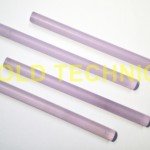
Neodymium doped Yttrium Aluminum Garnet Nd: YAG rods are the most commonly used solid state laser medium in many laser systems today.
The choice of using the lasing medium is clear, Nd:YAG rods offer:
- Low Lasing Threshold
- In high power laser machines, the dissipation of heat is efficient
- In comparison to other materials, Nd:YAG rods provide high conversion efficiency of power and good absorbtion (Optical)
Our Nd:YAG Rods are coated with AR (Anti reflection) coating to ensure higher energy output and efficiency.
Common sizes of our ND:YAG Rods are as follows:
- Diameter Ø3mm x Length 65mm
- Diameter Ø4mm x Length 65mm
- Diameter Ø6.35mm x Length 85mm
- Diameter Ø8mm x Length 85mm
- Diameter Ø10mm x Length 85mm
- Diameter Ø12mm x Length 100mm
To optimise the beam quality and maximise the output power of a laser, the correct laser medium and dopant level needs to be selected. On enquiry, do inform us the laser machine which you will be using the ND:YAG rod in, and we will be able to advise which laser rod is suitable for you. We provide solid state laser users with the largest comprehensive range of OEM Laser Nd: YAG rods and assemblies available.
Gold Technic Laser also provides a comprehensive laser Nd: YAG rod refurbishing service. Both un-mounted and mounted laser rod assemblies can be refurbished, subject to rod integrity and serviceability of the original rod assembly or the availability of suitable hardware. Common repairs which we perform are as follows:
- End of Laser Nd: YAG Rod is chipped – Provide grinding of chipped end (Laser Rod will be shortened)
- Side of Laser Nd: YAG Rod (length) is chipped – Provide grinding of diameter (Laser Rod will become slimmer)
- End surfaces of Nd: YAG Rod is worn – Re-grind end and re-coat with AR (Anti reflection) coating (Laser Rod will be shortened, new AR Coating applied)
Visit out our Laser Nd: YAG Rod repair page for more information.
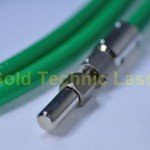
Gold Technic can supply new Laser Optical Fibers of any length and core size for various laser welding applications. The Laser optical fiber core is manufactured in Japan and with final assembly in Singapore.
Laser power transmission fibers are commonly used in laser welding machine. In the field of jewelry chain welding, Laservall and Sisma machines. In the field of electronics and engineering, Miyachi, Mitsubishi, Japan’s NEC, Han, United win, Riverstone, Metropolis, Everbright Laser etc.
Some commonly used sizes are listed below
| Laser Fibre Size | Length | Connector Type | Standard Colour |
| 300 micron | 3m/ 5m/ Others | D80 compatible | Green |
| 400 micron | 3m/ 5m/ Others | D80 compatible |
| 600 micron | 3m/ 5m/ Others | D80 compatible |
| 800 micron | 3m/ 5m/ Others | D80 compatible |
| Other sizes | Please Enquire | Please Enquire |
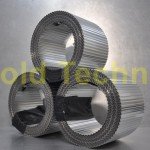
Corrugated stainless steel furnace belt
These furnaces are particularly suited for:
• Chain welding
• Metal finding welding
• Sheet and tube welding.
• Enamelling.
Material
High performance stainless steel belts designed for applications at 850-1100°C
Increased performance due to good mechanical properties, partly due to their austenitic structure and certain alloying elements.
Resistant to high-temperature corrosion
Good mechanical strength at elevated temperatures
Consistent corrugated surface to ensure even distribution of heat around the article.
Available in various size and configurations
Durable, lifespan 20% longer than ordinary belts.
Fully recyclable and environmental friendly.
Benefits of using our belts
New cost effective design
High grade homogeneous stainless steel for even distribution of heat.
Easy to connect and disconnect when changing belts. One step secure connection.
Increase usable surface area for chain production.
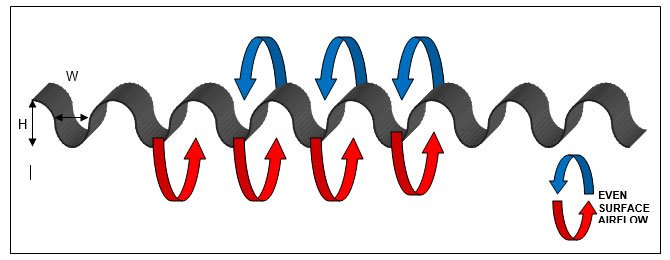
| Model | FT10200 | F10450 | F6400 | Any Size |
| Dimensions : | | | | |
| Length (mm) | 10200 | 10450 | 6400 | |
| Width (mm) | 70 | 96 | 78 | – |
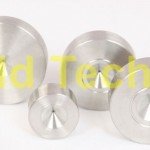
Unique features of ND wire drawing dies
- Able to produce the best wire surface finish among all types of dies.
- Lowest die pull and friction.
Applications
- Fine wire and ultra fine wire applications demanding a superior wire surface finish.
- Suitable for jewellery chain production.
Size range
Natural diamond wire dies (ND dies) Typical ranges (both smaller and larger sizes are available on request):
- 0.007 to 2.00 mm (.00027 – .0787”)
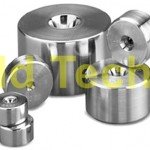
Unique features of TC wire drawing dies
- Highly wear resistance.
- Available in a large range of sizes and shapes
- Cost efficient
Applications:
- We would suggest PCD dies for drawing of ferrous metals as TC dies are the most resistant to these materials.
- Recommended for large size steel wire drawing
Size range
Tungsten carbide wire dies (T/C dies) Typical ranges (both smaller and larger sizes are available on request):
- 0.127 to 76.2 mm (.005 – 3.000”) – tungsten carbide wire dies (T/C dies)
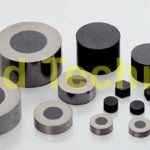
Unique features of PCD wire drawing dies
- Highly wear resistance
- Longer die life as compared to ND dies
- Resistant to fracture and wear
- Characterized by an even wear that maintains wire roundness
Applications:
- Polycrystalline diamond dies are excellent for drawing nonferrous wire, such as aluminium, copper, stainless steel and are especially well-suited for larger wire sizes where die life is more important than wire surface finish.
- Users of PCD dies may combine their drawing line with ND dies. ND diamond die may be used towards the end of the wire drawing process if the desired end result is a superior surface finish.
Size range
PCD wire dies (PCD) Typical ranges (both smaller and larger sizes are available on request):
- 0.040 to 35.0 mm (.00157 – 1.378”) – polycrystalline diamond wire dies (PCD dies)
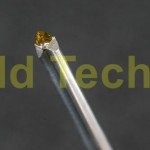
Description/material:
Single crystal diamond
Application:
A pilot hole is a smaller hole drilled into a material prior to a larger hole being drilled, widening the hole to the desired width. Drilling a pilot hole prevents a larger drill bit from slipping on the material – a potential safety hazard, as well as an increased likelihood of the work being damaged.
Our high precision Centre Point milling tools are long lasting and resistant to wear. They leave a very clean cut on the finished surface. The operator also saves time as there is no need for frequent change of tool, hence reducing down time of the machine.
It is recommended to be used only on CNC machines where no manual intervention is required
An air spindle running at least 20000 rpm is required to be used with the pilot hole drill to reduce vibrations. This can provide stability for the tool, thereby extending its lifespan. At the same time, the optimum result will also show on the machined piece as a highly polished mirror surface.
Description/material:
Single crystal diamond
HSS / carbide shank
Application:
It has a high level of wear resistance and allows high cutting data together with long tool life. The superior edge integrity will give you an excellent surface finish as well.
Description/material:
Single crystal diamond
HSS / carbide shank
Application:
Diamond Parting Tool for parting of plastic injection moulding stem for a clean finish.
For use on single axis or 2 axis machining. Tool clearance can be made in cylindrical, conical or pyramid form depending on the application and the amount of clearance needed. For single point turning, a cylindrical form of the radius is suitable. The cylindrical radius size doesn’t change after every relap hence it typically have a longer lifespan. However because of the cylindrical clearance, from the point of the tool towards the sides, user will have less clearance.
For 2-axis machining, a conical shaped tool is preferred because the profile of the diamond tool over the entire cutting edge is the same; consequently cutting conditions also remains largely constant.